Which Retaining Wall Materials Are Best for a Pittsburgh Hillside?
There is no single best retaining wall material. The right one depends on how tall the wall is and what it holds up. For the longest life, choose masonry or concrete. A national home improvement magazine says properly installed masonry and concrete walls have no set limit on their lifespan.
Wood is the short-lived choice. One national cost guide puts wood walls at 20 to 40 years, and railroad ties are wood. Davis Demolition and Masonry builds all of these retaining walls in Pittsburgh, railroad ties included. We also tear out walls that have failed and build them back.
What are the main types of retaining walls?
Home retaining walls come in six common materials: segmental concrete block, poured concrete, natural stone, brick, timber and railroad ties. All of them need a solid base and a way for water to get out. The life figures below come from one national cost guide (guide) and one national home improvement magazine (magazine).
| Material | How it holds the soil | Typical life as the sources state it | Drainage and base needs | Where it fits |
|---|---|---|---|---|
| Segmental concrete block | Dry-stacked, set back into the bank, anchored with mesh | No set limit if properly installed (magazine) | Compacted crushed stone footing, drainage stone, perforated pipe | Garden beds, hillside cuts, most yard walls |
| Poured concrete | A solid wall on a reinforced footing | Up to 100 years (guide) | Footing below the frost line, weep holes, drainage stone | Tall walls, walls beside a driveway |
| Natural stone, dry-laid | Its own weight, leaned back | 40 to 100 years for stone (guide) | Crushed stone footing, drainage stone | Garden beds, low walls |
| Natural stone, mortared | Stone and mortar on a footing | 40 to 100 years for stone (guide) | Footing below the frost line, weep holes | A finished stone face |
| Brick | Brick in mortar on a concrete footing | No set limit if properly installed (magazine) | Footing below the frost line, weep holes | Matching a brick house |
| Timber | Spiked or pinned, anchored with T-shaped deadmen | Up to 40 years for ground-contact treated wood, about 20 for cedar (magazine); 20 to 40 (guide) | Crushed stone footing, drainage stone | Low garden beds |
| Railroad ties | Stacked and pinned like timber | The wood figures; ties are wood soaked in creosote (guide) | Crushed stone footing, drainage stone | Low garden walls |
The table leaves price out. For numbers by material, see what a retaining wall costs in Pennsylvania.
How do block and poured concrete walls hold back a hillside?
Segmental block walls are stacked dry on a compacted crushed stone footing. Each course sits a little behind the one below, so the wall leans back into the bank. On many block walls, mesh laid between courses anchors the wall to the ground behind it.
A poured concrete wall is one solid piece on a reinforced concrete footing, and it stands straight up. A national home improvement magazine calls poured concrete the strongest and most durable option available. It also says professional design and installation are typically required.
Both walls need a way for water to get out. Clean drainage stone goes behind the wall, with a perforated pipe at the base run out to daylight. A poured wall also needs weep holes through it.
Is natural stone or brick a good retaining wall material?
Yes, when it is built for the job. One national cost guide puts stone walls at 40 to 100 years. A dry-laid stone wall holds the bank with its own weight and leans back into the slope. A national home improvement magazine lays out a mortared stone wall with a lean of about 1 inch for every foot of wall height.
Dry stacked stone needs only a crushed stone footing. Mortared stone and brick walls rest on a rebar-reinforced concrete footing set below the frost line. They need weep holes to relieve soil pressure. Over time a brick wall’s joints wear and need brick pointing, the same as a house.
How long do timber and railroad tie retaining walls last?
Wood walls have the shortest life. A national home improvement magazine says pressure-treated pine and fir rated for ground contact can last up to 40 years. It puts cedar or redwood at about 20 years. One national cost guide gives wood walls 20 to 40 years.
Timber and tie walls are held together with spikes, screws or rebar. T-shaped timbers called deadmen run back into the bank to anchor the wall.
Railroad ties are wood soaked in creosote, one national cost guide notes. EPA also says creosote pesticide products are not available to homeowners. Creosote-treated railroad ties are sometimes recycled as landscaping timbers, and EPA does not regulate that reuse under pesticide laws.
So the wood figures apply to ties too. A wall built from recycled ties starts with wood that has already been in service.
What fails first on a Pittsburgh hillside?
Pennsylvania’s Department of Conservation and Natural Resources says southwestern Pennsylvania has by far the highest concentration of landslides. The agency calls backyard landslides common in the Pittsburgh area. Across the state, many slides happen in loose soil and old landslide debris on steep slopes.
Water behind the wall is the usual first problem. Rain soaks the soil behind a wall and adds weight that pushes on it. When the drainage stone clogs or the weep holes stop draining, that pressure builds. A national home improvement magazine says good crushed stone backfill helps prevent the soil pressure that leads to costly rebuilds.
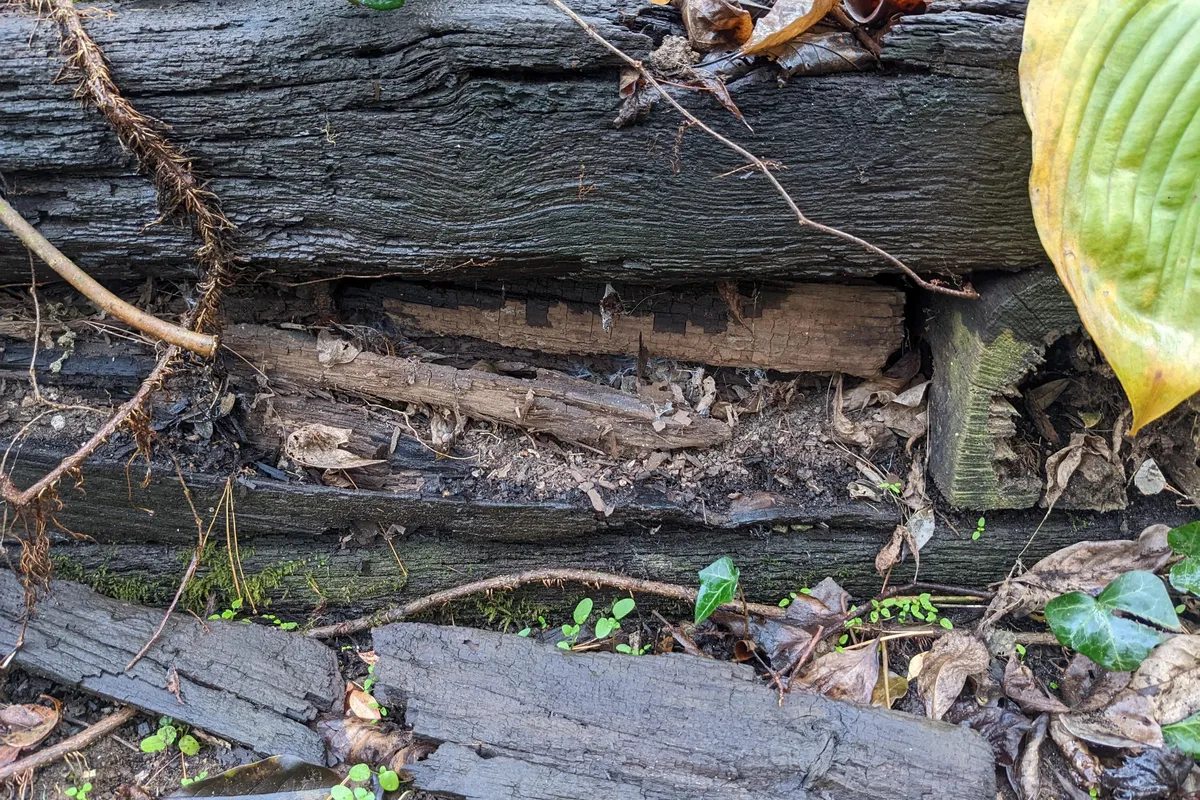
Timber and ties rot at the bottom course, the spikes let go and the wall bellies out. Block walls lean out at the top or bulge in the middle. Mortared walls crack, and the mortar washes out of the joints.
Digging into the slope below a wall can push it over. So can a driveway or a shed added above it.
When should a railroad tie wall be rebuilt in another material?
Rebuild in another material when the bottom ties have rotted and the wall leans or bellies out. Patching rotten ties only buys time. Switch to block, stone or poured concrete for a tall wall, a wall under a driveway or a cut hillside.
One national cost guide notes that railroad ties are banned in some municipalities, so check first. A low garden bed is still a good spot for ties if you want the look.
Demolition is our main line of work, so the tear out stays with us. The old wall comes out with the excavator, skid steers and air jackhammers. The ties leave with the rest of the debris as part of our debris removal and hauling.
Do you need a permit or an engineer for a retaining wall?
Pennsylvania’s Uniform Construction Code exempts residential retaining walls not over 4 feet high from a permit. Height is measured from the lowest level of grade to the top of the wall. The exemption does not cover a wall that supports a surcharge, such as a driveway above it. It applies only when the work does not violate a local law or ordinance.
The City of Pittsburgh draws the same line, measured the same way. Its zoning FAQ lists retaining walls 4 feet or less under work not requiring a building permit or zoning approval. A wall supporting a surcharge is not on that list.
Outside the city, your borough or township code office, or the code agency it uses, sets the rule. Plum Borough, for example, requires a building permit for retaining walls over 4 feet.
Walls over the height the code sets need an engineer’s design and a permit. A national home improvement magazine notes that local codes often require an engineer’s design for walls over 4 feet. We build the wall to that design. When we quote the job, we go over what your municipality requires and who handles each step.
Which retaining wall material is right for your yard?
Start with the height and the load above the wall, then choose the look. We look at the wall and the slope behind it, then give you a price before any work starts.
Davis Demolition and Masonry is based in Pittsburgh and works about 40 miles around. Retaining walls are part of our masonry work. Read how we build and rebuild retaining walls, or call or text (412) 720-1866.