How Much Does Concrete Removal Cost in Pennsylvania?
Concrete removal costs $2 to $6 per square foot in one national cost guide. A second national guide puts it at $3 to $8 per square foot, including disposal. At the first guide’s rate, a 12 by 12 foot patio comes to $288 to $864.
Cost guides also price whole jobs. The second guide puts driveway removal at $1,200 to $4,500 for 200 to 600 square feet. These are national market numbers, not Pennsylvania prices and not our price list.
We break out and haul off driveways, patios, sidewalks, slabs, steps and old footers around Pittsburgh. Our concrete removal page covers how that work gets done. Where your job lands comes down to thickness, rebar, access and the haul.
What does concrete removal cost per square foot?
Cost guides price removal by the square foot of slab, which is length times width. The first guide lists $2 to $6 per square foot on both its patio and sidewalk pages.
The second guide’s $3 to $8 per square foot includes disposal. Its low end is plain concrete, and its high end is reinforced concrete. That guide also says smaller jobs cost more per square foot than large ones.
At the first guide’s $2 to $6 rate, the math runs like this:
- A 4 by 25 foot walk is 100 square feet, or $200 to $600.
- A 12 by 12 foot patio is 144 square feet, or $288 to $864.
- A 12 by 16 foot shed pad is 192 square feet, or $384 to $1,152.
- A 10 by 40 foot driveway is 400 square feet, or $800 to $2,400.
At the second guide’s $3 to $8 rate, that same driveway comes to $1,200 to $3,200. The guides differ, so treat either range as a starting point.
How much does it cost to remove a driveway, patio or sidewalk?
The second guide also lists prices for common jobs. Its ranges are national averages for each kind of removal. The right column is what that guide says moves the price.
| Job | Typical range as the guides state it | What drives it |
|---|---|---|
| Concrete removal, per square foot | $2 to $6 (first guide); $3 to $8 with disposal (second guide) | Thickness, rebar, size of the job |
| Driveway, 200 to 600 square feet | $1,200 to $4,500 | Size, rebar, the excavator the job needs |
| Patio, 20 by 20 feet | $1,200 to $3,000 | Attached to the house, masonry built in, walls or railings |
| Sidewalk, 50 feet long | $750 to $1,250 | Width, depth, access |
| Slab or shed pad, 10 by 10 feet | $300 to $800 | Rebar, thickness over 4 inches |
| Concrete steps | $250 to $500 | Solid or hollow, lifting equipment |
| Garage floor, two-car garage | $1,000 to $3,500 | Breaker equipment and the haul |
| Concrete wall, 50 feet long | $250 to $800 | Height, thickness, backfill behind a retaining wall |
The per-square-foot row draws on both guides. Every job row below it comes from the second guide.
Footers and old foundation walls usually come out with the building that sat on them. They get priced with that job. Our garage demolition page covers the slab and footings under a garage.
What drives the price of concrete removal?
Thickness comes first. The second guide says slabs over 4 inches thick take heavier equipment and longer to remove. Most sidewalks are not reinforced, and that guide says this cuts labor time.
Rebar or wire mesh adds to the bill. The second guide adds $1 to $3 per square foot for reinforced concrete. That covers cutting and disposing of the steel. On a 400 square foot driveway, that adds $400 to $1,200.
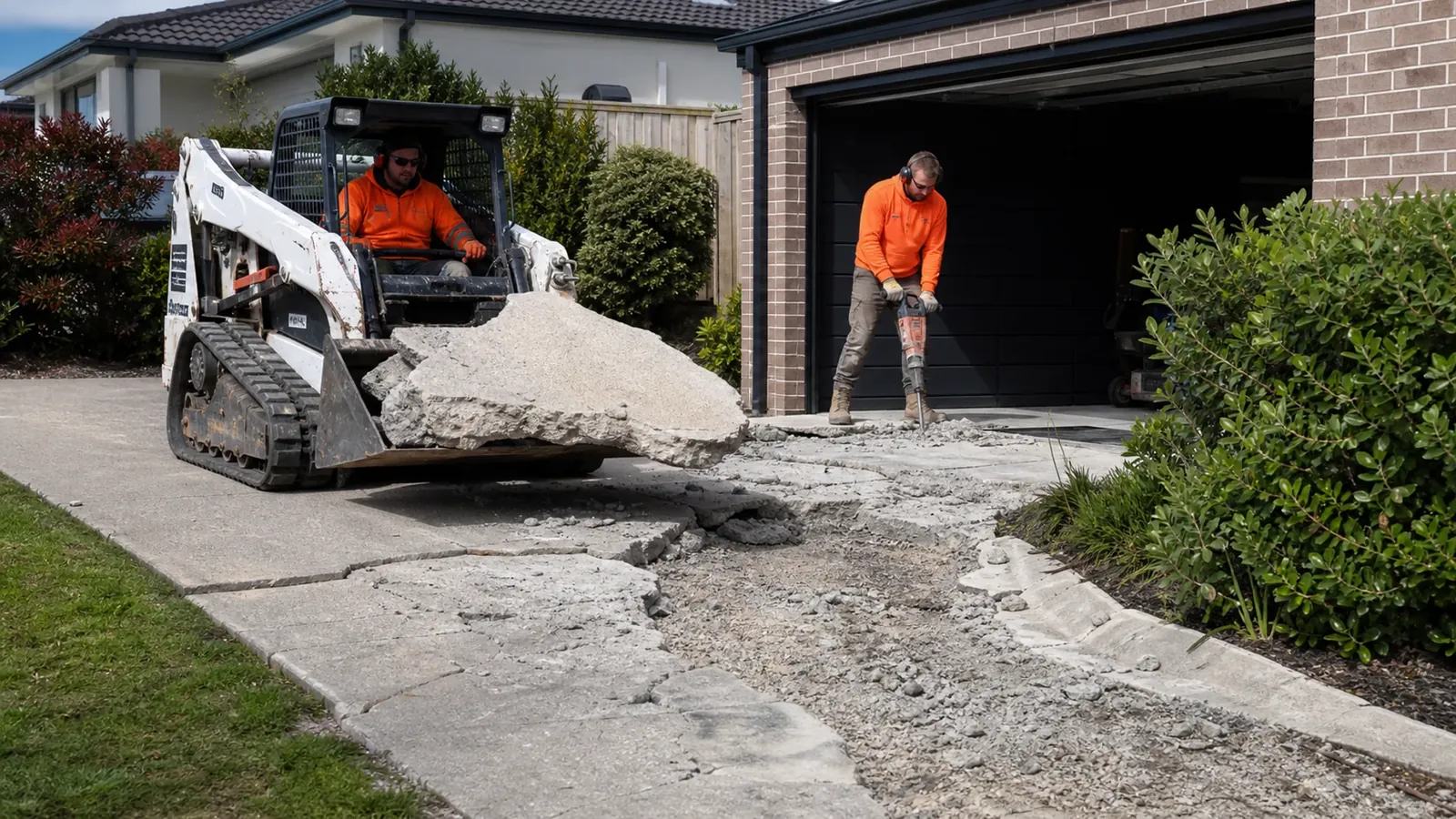
Access decides the tools. In an open driveway, the excavator and a skid steer break the slab and load it. The second guide says a driveway costs more to break up than a slab because of the excavator it needs.
Where no machine fits, such as a yard behind a narrow gate, air jackhammers do the breaking. On a tight city lot or a steep South Hills yard, the pieces go out by hand or wheelbarrow. The second guide notes that some companies charge extra to carry concrete up and down flights of stairs.
Where part of a slab stays, a saw cut marks a clean line before any breaking starts. The second guide puts concrete cutting at $5 to $15 per linear foot.
What sits under the slab counts as well. An old footer has to come out with it. A buried line has to be found before anyone digs.
Where does broken concrete go, and what does disposal cost?
Disposal is part of the price. Concrete is heavy, and the second guide lists dump fees of $90 to $160 per ton. It adds that longer hauls bring mileage fees.
In Pennsylvania, where to dump concrete depends on what is mixed into it. The state Department of Environmental Protection (DEP) has a rule for clean material. Using uncontaminated brick, block and concrete as clean fill does not require a permit. DEP has also issued general permits that let facilities process construction waste into aggregate.
A mixed load goes another way. The state’s waste rules count unsegregated concrete as construction and demolition waste. Clean concrete falls outside that group when it is kept separate from other waste and used as clean fill.
So we keep clean concrete apart from the rest of the debris as the job goes. When you get a price, ask where the load is headed. Our debris removal and hauling page covers everything else that leaves a job site.
Do you need a permit to remove concrete in Pittsburgh?
It depends where the concrete sits. A patio or slab on your lot is one question. The sidewalk, curb and driveway apron out front sit in the public right of way.
Inside the City of Pittsburgh, City Code 413.02 covers that strip. Work that cuts, alters or repairs a sidewalk, curb or driveway there needs a permit first. The Department of Mobility and Infrastructure (DOMI) issues it.
City Code 417.02 puts the care, repair and replacement of the sidewalk and curb on the abutting property owner. So a cracked city sidewalk in front of your house is yours to fix.
Outside the city, your borough or township code office sets the rules. When we quote the job, we go over what your municipality requires and who handles each step.
Digging below the slab brings in PA One Call. Pennsylvania’s Act 287 requires notice three to ten business days before excavation or demolition work. The utilities then mark the lines they own. Private lines that serve only your property are left out, so they need to be located some other way.
What happens to the ground after the concrete comes out?
Once the concrete is out, the ground sits low where the slab used to be. What happens next depends on what the space is for. If a new slab is going in, the base is left level and ready for the pour. If the yard is going back to lawn, the spot gets backfilled and topped with topsoil and seed.
We remove driveways, but we do not pour them, so a new driveway needs a paving or concrete contractor. The concrete we do pour is small work: concrete sidewalks and patios and small pads. For the cost of a new slab, see what a new concrete patio costs.
How do you get a price on concrete removal?
Davis Demolition and Masonry is based in Pittsburgh and has been in the demolition business since 2001. We work the city, the South Hills, the eastern suburbs and Washington and Westmoreland counties, about 40 miles around.
The ranges above are market numbers, not our price list. We look at the job and give you a price before any work starts. Read how we break out and haul concrete, or call or text (412) 720-1866.